To answer the question regarding Kendra and the four expansions of Nārāyaṇa, we must understand certain important charts used in Vedic Jyotiṣa.
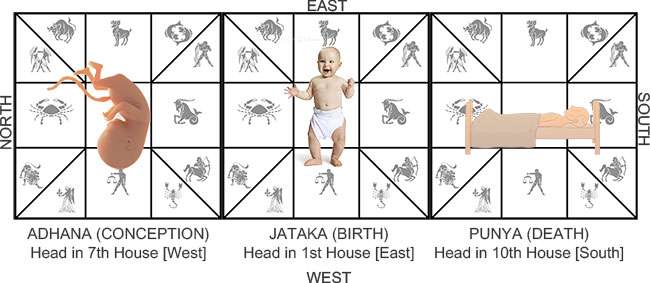
The first is Niṣeka, the union from which a child is conceived. Its timing can be calculated from the birth chart, though the process is complex; this chart is called the Niṣeka Chakra. However, more relevant is the conception chart known as the Ādhāna Chakra. In this chart, the rising sign (lagna) should be the 7th house from the birth chart.
In the birth chart, called Jātaka (from the root jāta, meaning “birth”), the head of the native is placed in the first house. This sign is always opposite to the sign rising at conception. Most sages and classical Jyotiṣa texts agree on this. For example, if a person has Pisces rising, then the conception lagna would have been Virgo, which is the 7th sign in the birth chart.
Finally, at the time of death, the body is always laid with the head towards the South, as it is the direction of Yama, the lord of death, and the soul journeys in that direction after death. The chart cast for the moment of death is called the Puṇya Chakra.
Thus:
- Ādhāna Chakra (conception chart) represents creation (sṛṣṭi)
- Jātaka Chakra (birth chart) represents sustenance (sthiti)
- Puṇya Chakra (death chart) represents dissolution (laya)
Homework
Study and understand the following terms:
Ādhāna, Niṣeka, Janma, Jātaka, Puṇya, Mṛtyu, Sṛṣṭi, Sthiti, Laya, Pralaya.
Expansion of Vāsudeva
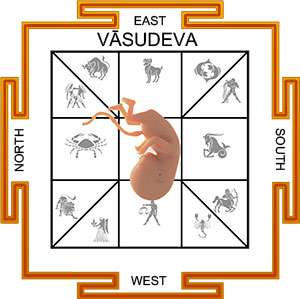
In the concept of the expansion of Nārāyaṇa, Vāsudeva is the developer, and the individual soul (jīvātman) is guided by him until the moment of birth. Birth is associated with the concept of vāha, which means “to flow,” “to carry,” “to deliver,” or “to transport.” This is an important Sanskrit root from which many Jyotiṣa-related terms arise, such as vivāha (marriage) and vāhana (vehicle). This action represents the primary role of Vāsudeva in his expansions.
To complete this understanding, Vāsudeva must be seen in the 7th house from the Ādhāna lagna, which becomes the birth lagna in the Jātaka chart.
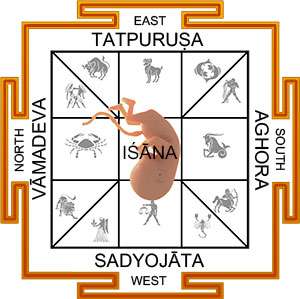
Sadāśiva is the supreme teacher (Parameṣṭhī Guru) who grants intellect to all beings. To accomplish this vast task, he must reside in the head. The brain is one of the few organs in the human body that has the power of regeneration and survival—this power comes from Śiva.
However, the head must ultimately control and coordinate all parts of the body. For this purpose, Sadāśiva expands into five forms:
- Sadyojāta (West) – seated at the head of the embryo; initiates impulses of creation
- Vāmadeva (North) – a combined form of Śiva and Viṣṇu
- Tatpuruṣa (East) – aligns with the Kālapuruṣa form of Vāsudeva
- Aghora (South) – removes impurities and defects arising in the body
- Īśāna (Upward) – transcendent, beyond the cycle, giving spiritual direction
The Īśāna form activates automatically in times of crisis to harmonize all centers and sustain life.
Other Expansions
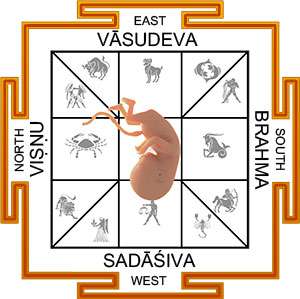
From the above, it is clear that Parama-Brahmā assumes the form of Brahmā, the creator, to construct the body of the being. For this, he must be placed in the 4th house from the Ādhāna lagna, representing the torso—the main structure of the body.
Finally, Mahā-Viṣṇu assumes the role of Viṣṇu to determine the birth of the child. This act is called tāraṇa, meaning to carry the fetus across or liberate it from the darkness of the womb. This concept continues throughout life and also represents the path of liberation from this world, which is why we refer to his manifestations as avatāras.