
ततस्तु श्रावणो भाद्रपदाथाश्चिनसंज्ञकः॥
कार्तिको मार्गशीर्षश्च पौशो माघोथ फाल्गुनः।
एतानि मासनामानि चैत्रा दीनां क्रमाद्विदुः॥
māsaścaitro tha vaiśākho jyeṣṭha āṣāḍha saṁjñakaḥ|
tatastu śrāvaṇo bhādrapadāthāśvinasaṁjñakaḥ ||
kārtiko mārgaśīrṣaśca pauśo māghotha phālgunaḥ |
etāni māsanāmāni caitrā dīnāṁ kramādviduḥ ||
Months are called Masa, and a year (samvatsara, varsha) has twelve months. These months are called—
Masa : Month
- Chaitra after the full moon in Chitra naksatra
- Vaisakha after the full moon in Visakha nakşatra
- Jyeştha after the full moon in Jyestha naksatra
- Asadha after the full moon in Purva or Uttara Asadha nakşatra
- Sravana after the full moon in Sravana naksatra
- Bhadrapada after the full moon in Uttara or Bhadrapada naksatra
- Asvina after the full moon in Asvini naksatra
- Kartika after the full moon in Krittika naksatra
- Margasişa after the full moon in Mrgasiras nakşatra
- Pausa after the full moon in Puşya naksatra
- Magha after the full moon in Magha naksatra
- Phalguna after the full moon in Uttara or Purva Phalguni nakşatra
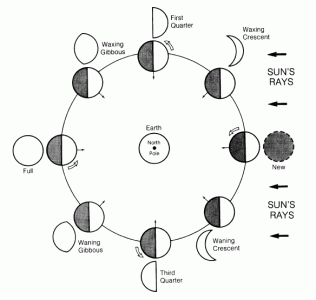
For the Moon to be full, the Sun must be opposite i.e. 180° away from it. When the Sun and Moon conjoin, then it is a new Moon and new Moon is always a dark Moon. The moon is dark over a longer period of time covering about two days. Therefore, it is difficult to fix the exact date of the new moon based on visibility. Instead, the full moon is clearly visible in the sky as the biggest moon of the month and can be readily used to dale the month. When the month is decided on the basis of the full moon, it is called purnanta (end of purnima or full moon) masa.
However, we can still count 15 days (fortnight) from the full moon to determine the new moon. If this new moon is used to reckon the months instead, it is called amanta masa from the name amavasya for new moon.
In the old pre-Vedic days man used the Sun, Moon and stars to keep time. It was easy to count the number of days based on sunrise, as every sunrise was a natural way for the public to count days.
So, this was used as the public calendar and it was decreed that 360 days would make a year. This was the Savana calendar having 12 Savana months of exactly 30 days each. However, the calendar masters knew that a typical year was about 365.25 days, and every year, the calendar would fall short of about 5.25 days. In 5 years, the calendar would be short by 26 days. Therefore, it was necessary to introduce one mala masa (dirty month literally) which would need to be added every 5th year to bring the calendar in harmony with the real year. In this manner the wise sages had a calendar Where five years were called the panca-varga sarvatsara where each samvatsara (year) had a specific name and had twelve months of 30 days each. The last year would have a mala masa to cover the days lost in the previous samvatara. These five samvatsar were called
The names of these five Samvatsaras are –
१. संवत्सर (Saṁvatsara)
२. परिवत्सर (Parivatsara)
३. इदावत्सर (Idāvatsara)
४. इद्वत्सर (Idvatsara)
५. अनुवत्सर (Anuvatsara) या वत्सर (Vatsara)।
The first thing to learn is to write the twelve months. We can do this in three ways at least, but we shall learn only two ways which are considered superior.
1 South–India Chart ( Guru Chakra)

We can make a box with sixteen squares, by drawing five horizontal and five vertical lines. And ignoring the four squares in the center, we can write the names of the 12 months in the boxes in the periphery. This is called the South Indian chart and is shown below. The advantage of this chart is that we can write all sixteen vowels of Sanskrit inside it as well. It is called the Guru Chakra, or the box of Jupiter and is the view of the zodiac when looking down to earth. Therefore, the months are written in clockwise manner. Try writing the names of the months and Sanskrit vowels in the empty chart as shown and say the names as you write so that you can remember them.
2 East–India Chart ( Surya Chakra)
The first thing to learn is to write the twelve months. We can do this in three ways at least, but we shall learn only two ways which are considered superior.
We can make a circle to represent the cyclic year and time which goes around. We can divide the circle into twelve parts by having twelve spokes in the Wheel with a hub at the centre. This is the East-India chart also called the Surya chakra (after the wheel of the chariot of the Sun god). The twelve months are written in the twelve areas marked by the spokes and the monosyllable an (om) is written at the centre. The twelve Sanskrit vowels, excluding are written with the twelve months. Note that the months are written in the anticlockwise direction. Try writing the names of the months and Sanskrit vowels in the empty chart as shown and say the names as you write so that you can remember them.

Essential Learnings
The names of the twelve lunar months and the positions of their corresponding constellations
The twelve Sanskrit vowels that make up the twelve months (months)
The four Sanskrit vowels that do not form a zodiac sign, but instead indicate the four gates of entry and exit
In which lunar month were you born? What was the sound associated with that zodiac sign? Is there a difference between a solar month and a lunar month?